

What Age Is Appropriate for Kids to Cold Plunge and Sauna?
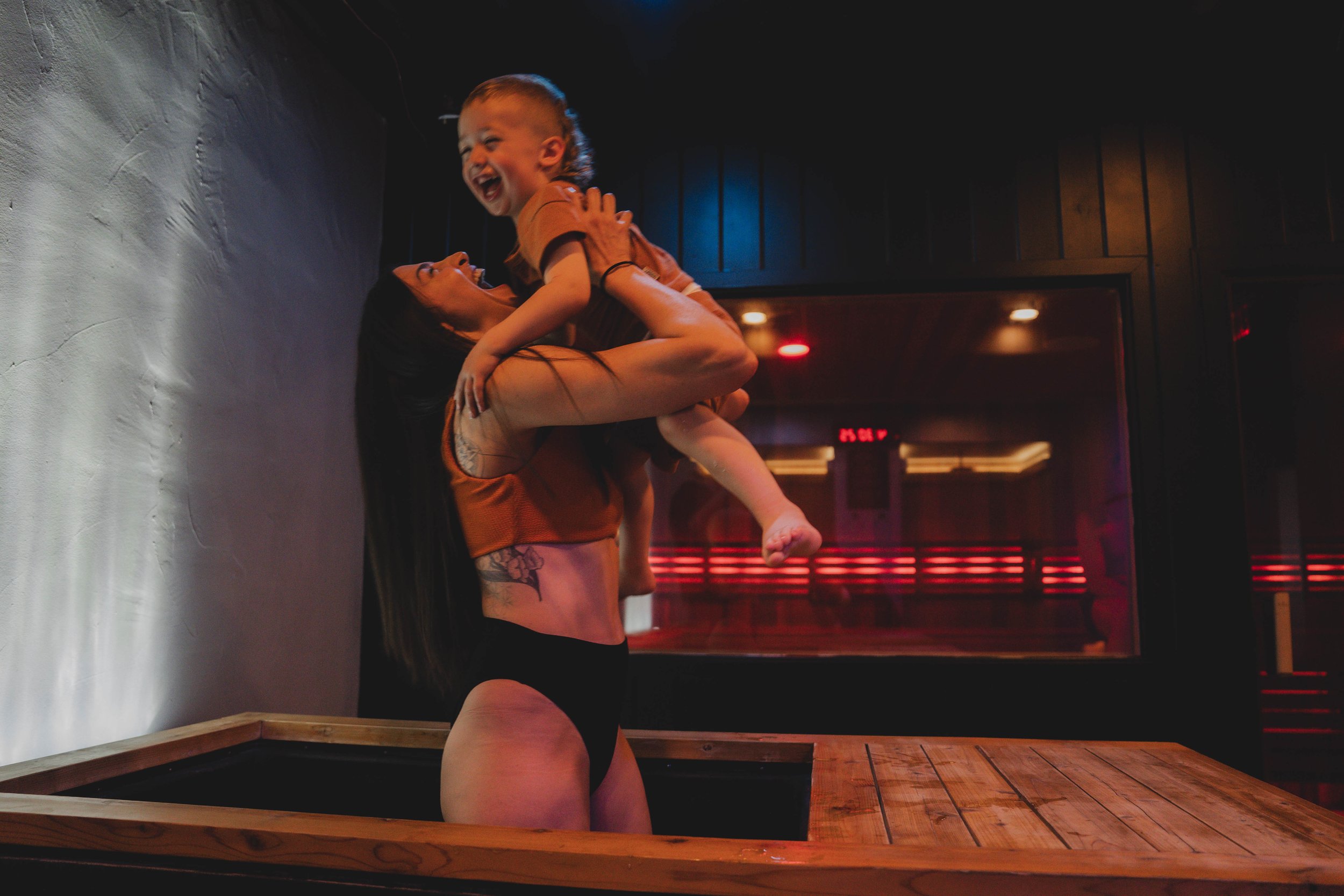
There is no magic age — a child is ready for contrast therapy when a parent is present and the child can communicate effectively about what they're feeling. Age is a proxy. Communication is the real threshold. A seven-year-old who can tell you "my fingers feel tingly" is safer in cold water than a twelve-year-old who's been told to tough it out. The rule that governs everything else: never force cold or heat on a child. Ever.
What Are the Rules Before a Kid Ever Gets In?
Two rules are non-negotiable, and both belong to the parent, not the child.
Rule one: you are present. Not in the building. Not watching from the lobby. Within arm's reach, the entire session. In Finland — where 98.5% of children use saunas, most beginning in infancy — children under about eight are never allowed in the sauna alone, and parents watch their kids during and after the session to see how they react to the heat. Two hundred generations of practice arrived at the same rule we start with.
Rule two: the child can communicate. They need the vocabulary and the trust to say "I'm done," "this hurts," "I feel dizzy" — and know they'll be pulled immediately, without commentary. Contrast is safe for kids because the exit is always open, not because the exposure is mild.
Force breaks both rules at once. A child pushed into cold water learns that their signals don't matter. That's the opposite of the lesson. Cold and heat should never be forced because the entire value of the practice is a child learning to read and trust their own system.
How Do You Actually Introduce It? Show, Don't Tell.
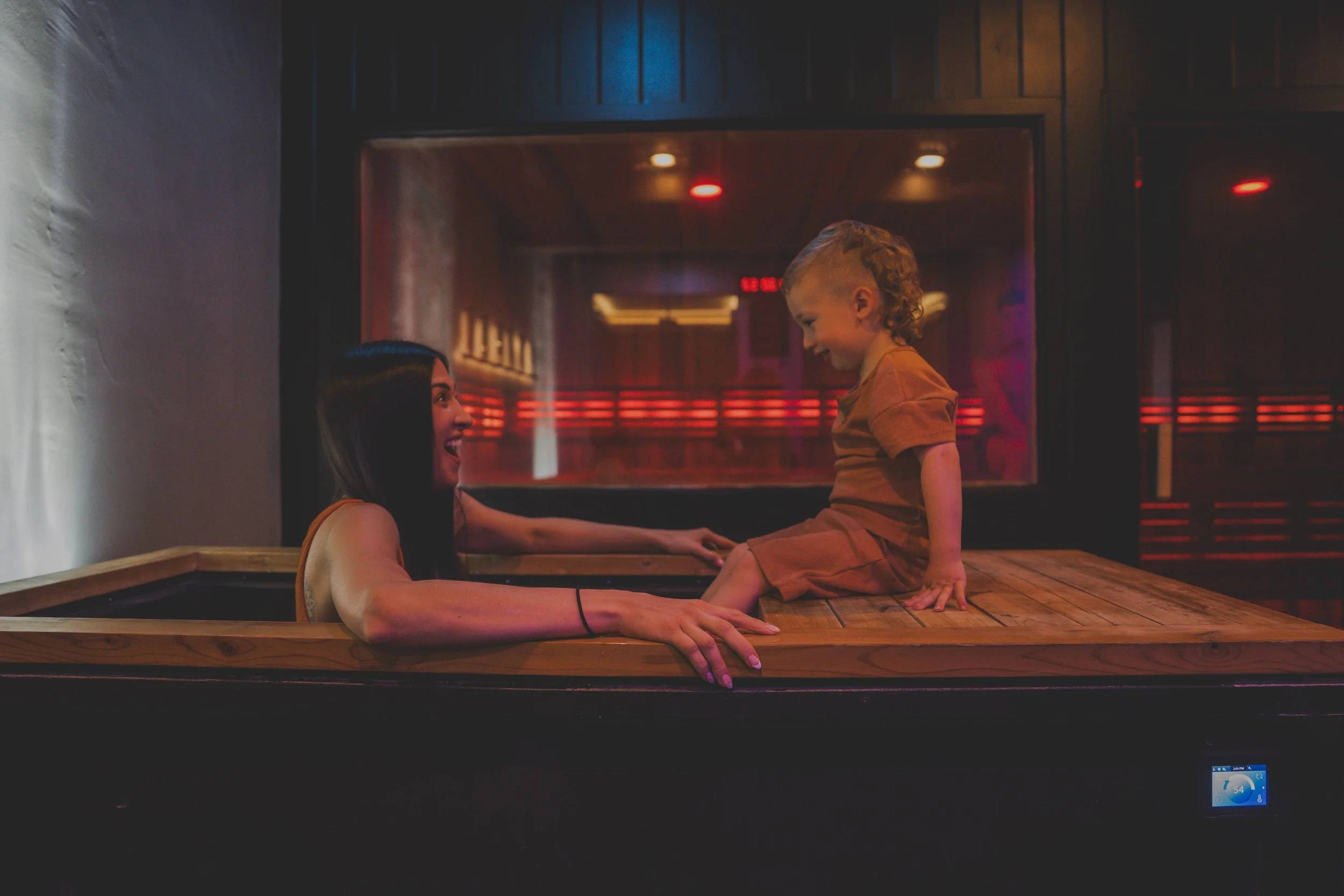
Kids react best to demonstration, not instruction. In our experience at Rytual, the fastest way to get a kid into cold water is to get in yourself, breathe, and say nothing. Children are pattern-matching machines. They watch your face at the moment of immersion. If you're calm, cold water becomes a normal thing humans do. If you're selling it, it becomes suspicious.
Let them approach it on their terms. Feet first. Hands in the water. A ten-second dip and out. Every voluntary exposure builds the account. Every forced one drains it.
Is Cold Water Actually Natural for Kids?
For roughly 200,000 years of human evolution, cold water was the default. Rivers, lakes, oceans, rain. Warm water on demand is about a century old. A child's thermoregulatory system is built by the same evolutionary history as yours — cold exposure isn't an exotic biohack for kids, it's a return to baseline conditions their physiology already expects. The novelty isn't the cold plunge. The novelty is a childhood that never touches cold water at all.
That said, natural doesn't mean unlimited. Short exposures. Warm-up available. Child controls the clock.
Why Be More Conservative With Heat?
Heat is different because children's bodies handle it differently. Kids' core temperatures rise faster than adults' — roughly 1.5°C in ten minutes at sauna temperatures — and younger children can experience blood pressure drops after heat exposure. The research that exists is reassuring — a review in The American Journal of Medicine found sauna bathing well tolerated by most healthy children, with a study of 81 kids aged 2–15 tolerating ten minutes well, older children adapting better than younger ones — but reassuring is not a license to push.
So the protocol is conservative on heat: lower temperatures, shorter sessions, lower bench, water in hand, and the child's own system designates what's appropriate. When they say done, they're done. The Finnish model is exactly this — parents observe post-sauna behavior and let that empirically set the limits, rather than imposing an adult protocol on a smaller body.
Cold, a kid self-limits fast — they'll get out. Heat is sneakier. That's why the adult carries more of the vigilance on the hot side.
What Do Kids Actually Get Out of It?
We've watched the effects of contrast therapy on kids at Rytual, and the pattern is consistent: better ability to cope with focus and hyperactivity, and a visible bump in confidence. A kid who voluntarily got into 45-degree water carries that with them. It's proof of capability that no one can hand them — they earned it in their own nervous system. (This is our observation from the floor, not a clinical claim. If your child has a diagnosed condition, talk to your pediatrician first.)
The second-order effects might matter more. Contrast is a great way to spend quality time with your kids — no phones survive a cold plunge. It normalizes two things at once: taking care of yourself, and challenging yourself. Kids who watch their parents do hard, restorative things on purpose grow up thinking that's just what people do.
And if nothing else: an hour in contrast is one less hour staring into a screen. That trade alone is worth the price of admission.
The Rytual Protocol for Kids
Parent or guardian present, within arm's reach, entire session
Child can communicate effectively — this is the readiness test, not a birthday
Nothing is ever forced; the exit is always open, no commentary
Show, don't tell — you go first
Cold: short, voluntary, child controls the clock
Heat: conservative — lower temps, shorter sessions, lower bench, hydrated, their system sets the limit
Watch them after the session, not just during — that's where you learn their limits
TL;DR
Readiness is communication plus supervision, not a specific age — a parent present and a child who can say "I'm done" is the threshold.
Cold or heat is never forced, because the practice only works if the child's signals are honored every time.
Cold water was the human default for 200,000 years; kids' physiology expects it in short, voluntary doses.
Heat demands more caution because children heat up faster than adults — be conservative and let their system set the limit.
The payoff is focus, confidence, real time together, and one less hour on a screen.
